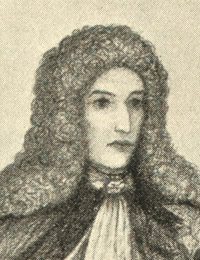
 Illust. by "J.B.T.", 1921
 |
|
9 January 1681- 6 May 1743
Raised a Calvinist, the Chevalier Andrew Michael Ramsay converted to Catholicism in 1709, although he was never entirely orthodox, as can be seen from his posthumously published The Philosophical Principles of Natural and Revealed Religion unfolded in Geometrical Order. (Glasgow: 1749)
Leaving England for Holland in 1709, he soon moved to Cambrai where he lived with the eminent mystical theologian, Fénelon (1651-1715), Archbishop of Cambrai and later, in 1713 or 1714, to Blois where he was employed as secretary to the founder of Quietism, Madam Guyon. Relocating to Paris in 1716, he spent the rest of his life in or near that city.
It was here that he met the Duc d'Orleans who admitted Ramsay as a member of the Royal and Military Order of St. Lazarus of Jerusalem, giving him the title of Chevalier. James, the Old Pretender, was persuaded to grant him a certificate of nobility in 1723 and five years later he succeeded in having a diploma of nobility registered by the King of Arms in Eninburgh.
In 1724 he travelled to Rome as tutor to Charles Edward, Prince of Wales, where he was introduced to Philip, Duke of Wharton, He returned to Paris within the twelve month.
In 1729 he travelled to London where he was elected to fellowship of the Royal Society and initiated into Freemasonry the following year before returning to Paris.
Ramsay was once widely credited with introducing the Knights Templar lineage into what has been termed the masonic Orders of Chivalry, and for creating several such degrees. In fact Ramsey did nothing more than deliver an oration in Paris on 27 December 1736 [long thought to have been delivered on 21 March 1737] in which he expounded a Crusader transmission of masonic teachings. While he never promoted the creation of additional orders or degrees, he mentions the Templars once, in his posthumously published Philosophical Principles of Natural and Revealed Religion (1749), where he states that "every Mason is a Knight Templar."
It was Ramsey's request to Cardinal de Fleury to support Freemasonry which appears to have, in 1738, directly lead to Louis XV publishing an ineffectual edict prohibiting all loyal subjects from associating with Freemasonry, and Pope Clement XII to issue his Bull in Eminenti Apostulatus Specula on 17 April 1738— a bull which was never promulgated in France.
Masonic historian Henry Coil notes: "For one who reached such notoriety, Ramsay’s masonic career was unusually obscure."
Initiated: 16 March, 1730
Horn Lodge in the Palace Yard, Westminster
Founding member
Louis l'Argent Lodge
Grand Chancellor
Grand Orator
Grand Lodge of Freance
Source: Ars Quatuor Coronatorum, pp. 280-315 vol 81 (1968). Much of Ramsay’s life is only known from Anecdotes de la vie de Messire André Michel de Ramsay a manuscript dictated by Ramsay, and now in the Bibliotèque Méjanes at Aix-en-Provence. Cited AQC, vol 81 (1968). Cf. Mackey’s Encyclopedia for a 1680 birthdate. The portrait—not a life study—appeared as the frontispiece to Arthur Edward Waite’s A New Encyclopaedia of Freemasonry, "Ars Magna Latomorum", London : Rider & Co., 1921. vol. i.
|
![[Search]](../../images/hedn.jpg)
![[Calendar]](../../images/calendar_buttonn.gif)
![[Search]](../../images/search_buttonn.gif)
![[Resources]](../../images/resources_buttonn.gif)
![[History]](../../images/history_buttonn.gif)
![[Links]](../../images/links_buttonn.gif)
![[Sitemap]](../../images/sitemap_buttonn.gif)
![[Anti-masonry]](../../images/s&c_blue.png)